Spinal Curvature
We may evaluate the overall shape and curvature of the spine and whether those patterns may be relevant to your findings.
DIGITAL IMAGING
Pain doesn't always tell the whole story.
At Trinity Chiropractic Center, our goal is to understand the person in front of us as clearly as possible before recommending care.
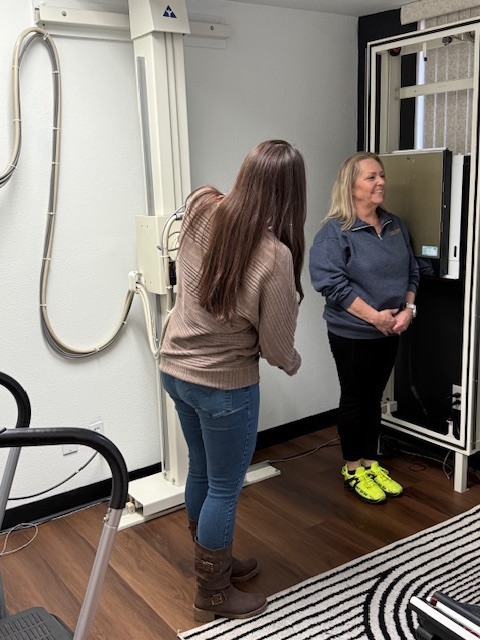
When clinically appropriate, digital X-rays can give Dr. Branden additional information about spinal structure, alignment, degeneration, disc spacing, bone appearance, and other findings that may help explain what is happening beneath the surface.
Imaging is only one part of the picture. We consider your history, symptoms, movement, examination findings, goals, and imaging together when developing a personalized chiropractic plan.
LOOKING BEYOND THE SYMPTOMS
Symptoms are important — but they are not the only thing we consider.
Two people can have similar pain and very different structural findings. Likewise, some people have changes visible on imaging without significant symptoms at all.
When X-rays are appropriate, they help Dr. Branden look more closely at spinal structure and place your symptoms in the context of what is happening physically.
That information can help guide conversations about your findings, what type of chiropractic care may be appropriate, and what goals make sense for your care plan.
WHAT WE LOOK AT
Dr. Branden looks at the images as part of the larger clinical picture.
We may evaluate the overall shape and curvature of the spine and whether those patterns may be relevant to your findings.
Changes in the spaces between vertebrae can provide additional information about long-term structural changes in the spine.
X-rays can show structural changes such as joint wear, bone spurs, altered joint shape, or reduced disc height.
Dr. Branden also considers the general appearance of the bones and whether anything visible warrants additional evaluation.
PART OF OUR MISSION
We don't want to make recommendations based on one symptom or one image alone.
Your health history, what you're experiencing now, how your body is moving, your examination findings, and imaging when appropriate all contribute to the conversation.
X-rays can help us better understand structural findings, but they don't replace listening to you or evaluating how you're functioning.
Our goal is to put those pieces together so your care plan is based on your individual findings rather than a standard template.
OUR APPROACH
We want you to understand what we're seeing and why it matters before moving forward with care.
AN IMPORTANT DISTINCTION
X-rays are useful for looking at bone and spinal structure, but some concerns require a different type of imaging.
01
Best for evaluating bone and overall structure
X-rays can help show spinal curvature, vertebral structure, disc spacing, degenerative changes, and other bony findings.
02
A closer look at discs, nerves, and soft tissues
If Dr. Branden suspects a disc problem, nerve involvement, or another concern that cannot be adequately evaluated on X-ray, he may recommend outside imaging such as an MRI.
WHEN OUR OFFICE IMAGING ISN'T ENOUGH
Our in-office digital X-ray system works well for many patients, but it has limitations.
In some cases, the equipment may not be able to produce an image with enough detail for Dr. Branden to evaluate confidently.
When that happens, we may refer you to an outside imaging facility with equipment better suited to obtaining the images we need.
We would rather send you for better imaging than rely on an image that doesn't give us enough useful information.
THE RIGHT IMAGE MATTERS
The goal isn't simply to take an X-ray because we have a machine. The goal is to obtain useful information when imaging is clinically appropriate.
INDIVIDUALIZED DECISIONS
Imaging should have a reason behind it.
Dr. Branden considers your history, symptoms, age, examination findings, previous imaging, and other clinical factors when deciding whether an X-ray is appropriate.
If imaging isn't likely to add useful information or change the way your care is approached, it may not be necessary.
Your health and injury history
Your current symptoms and concerns
What Dr. Branden finds during the evaluation
Whether imaging would add useful clinical information
UNDERSTANDING YOUR FINDINGS
When imaging is part of your evaluation, Dr. Branden reviews the images before discussing the findings with you.
Dr. Branden carefully reviews your images along with the rest of your clinical information.
At your Report of Findings, he'll walk through the findings that are relevant to your care.
Imaging is considered alongside your symptoms, movement, history, and examination — not interpreted in isolation.
Those findings help guide the type, frequency, and goals of care Dr. Branden recommends for you.
STRUCTURE & SYMPTOMS
Structural changes can develop gradually over time.
Some people have significant degenerative findings with relatively little pain, while others experience symptoms even when imaging changes appear mild.
That's why Dr. Branden does not make recommendations from an X-ray alone. Imaging helps tell part of the story — your symptoms, history, function, and examination help tell the rest.
Learn More About Degeneration & Our 3 Phases →THE BIGGER PICTURE
Understanding both your symptoms and your structural findings helps us have a better conversation about what we're seeing and what your care may realistically work toward.
START WITH THE WHOLE PICTURE
Your first visit starts with a conversation and evaluation. When imaging is clinically appropriate, it becomes another tool to help us understand your findings and build a care plan around you.